

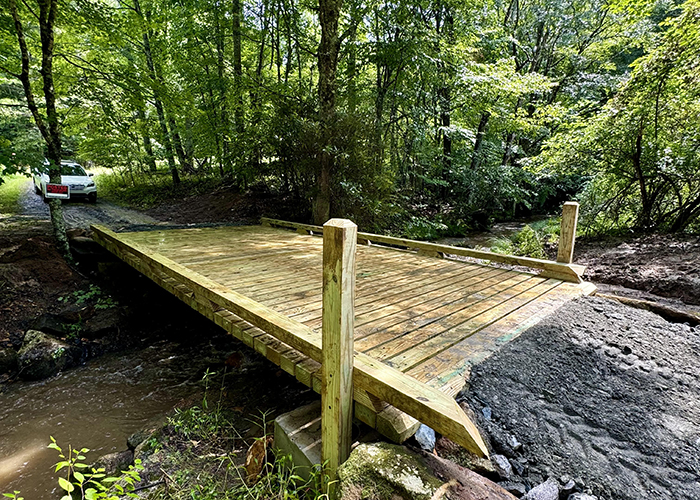
This West Jefferson, North Carolina project centered on a steel truss bridge and the earthwork required to make the crossing usable. A bridge structure may be the most visible part of the project, but it only functions when the approaches, bank elevations, foundation areas and drainage around it work together.
Bridge projects concentrate several site constraints in a small area. Vehicles have to transition smoothly onto and off the structure, the banks have to support those approach grades, equipment needs access for construction, and runoff from the road cannot be allowed to erode the crossing.
The reason approach grading matters is that even a properly designed bridge can be difficult to use if the road reaches it at an abrupt angle or excessive grade. The road and the bridge should feel like one continuous access route.
Creek and river banks are naturally exposed to water and erosion. Earthwork near the bridge therefore needs to consider both the loads from the approach and the condition of the bank beneath or beside it. Loose or irregular ground may need to be reshaped or stabilized before the approach can be completed.
Where stone is used around banks or approach areas, the purpose is typically to protect vulnerable soil, create a stable transition or support drainage—not simply to improve appearance. This is why bridge site preparation often overlaps with bank stabilization.
A road naturally carries runoff toward low points, and a bridge crossing is often one of those low areas. Without deliberate drainage, water can run down the approach and erode the edge of the road, wash material toward the creek or undermine the transition near the structure.
Road pitch, ditches, culverts where appropriate and stabilized outlets should move water away from sensitive approach areas. The reasoning is to prevent the bridge from becoming the collection point for the entire road’s stormwater.
Access and clearing have to be established first so excavation and hauling equipment can safely reach the crossing. Foundation or abutment-related earthwork and bank preparation can then be completed at the required elevations. Once the structural portion is in place, the approaches can be graded and tied back into the existing road, followed by stabilization and finish material.
That sequence prevents finish road work from being damaged by the heavier bridge construction that still has to pass through the site.
The goal is a crossing that functions as part of the road system rather than as an isolated structure. Vehicles should be able to approach it comfortably, banks and transitions should be stable, and runoff should have a controlled route that does not attack the bridge approaches.
Carolina Dozer performs bridge-related excavation and grading in West Jefferson and throughout Western North Carolina, combining road building, bank work, drainage and heavy-equipment access around the same practical objective: make the entire crossing work, not just the bridge itself.
Related guide: Riprap vs. Clean Stone for Erosion Control.


MEDIA
WORK
FAQ’S

.jpeg)


.jpg)