

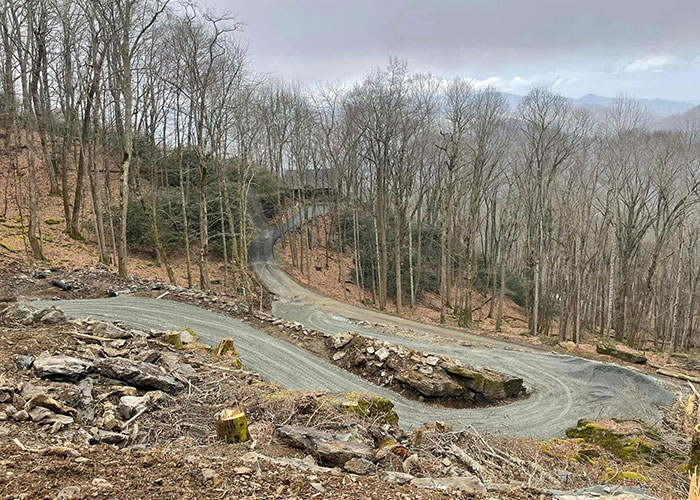
This Western North Carolina project involved construction of approximately a half-mile mountain driveway near Blowing Rock. A road of that length is a small infrastructure project in its own right. Every change in elevation, every drainage crossing and every section of cut or fill affects how the road performs during storms and under regular traffic.
Long private roads fail differently than short residential driveways. Water has more distance to collect, small grading errors have more time to become erosion channels, and one poorly drained section can send runoff into the next several hundred feet of road. Steep terrain also limits where equipment can turn, where material can be staged and how the route can be shaped.
The reason alignment matters so much is simple: a road that constantly fights the natural terrain usually requires more excavation, more retaining or stabilization and more maintenance. The route needs to balance practical grade, usable width, drainage and the amount of earth that must be moved.
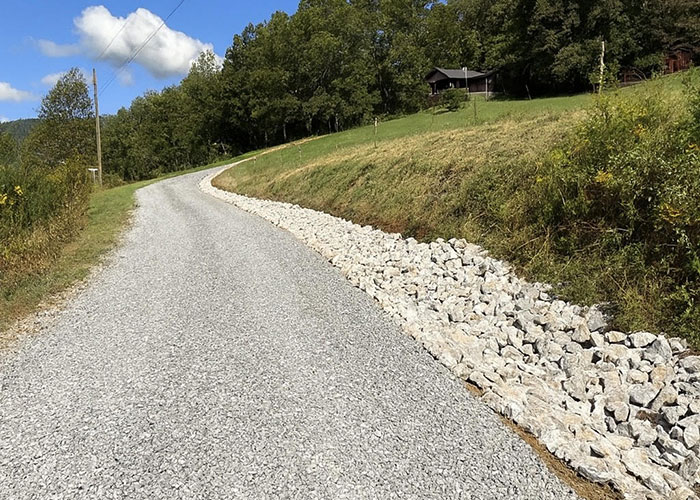
For a half-mile mountain driveway, crown, cross-slope, roadside ditches and culverts have to work together. The objective is to move runoff off the travel surface at controlled locations before it gains enough volume or speed to wash stone downhill. This is why driveway drainage and culvert work is closely tied to private-road construction.
Simply placing gravel on a long road without first shaping the underlying grade can create a surface that looks finished but remains vulnerable. The base and drainage determine whether the stone stays in place.
Mountain-road work is typically most efficient when clearing and access come first, followed by rough excavation and shaping, then drainage, stabilization of weak areas and final aggregate placement. That order matters because installing finish stone before the road has been fully shaped can lead to material being contaminated, buried or moved again.
On a long route, work also has to progress in a way that keeps equipment access open. The contractor cannot treat each section in isolation; the entire road has to remain connected and usable as construction moves forward.
The objective is dependable year-round access that can handle normal vehicles, deliveries and future construction traffic while shedding stormwater in a controlled way. A well-built mountain road will still require maintenance over time, but it should not require a new load of gravel every time heavy rain occurs.
This project reflects the same approach Carolina Dozer uses for excavation in Blowing Rock and throughout the High Country: follow the terrain where practical, manage water early, and build the road from the subgrade up rather than treating gravel as the solution to every problem.
Related guide: Why Does My Gravel Driveway Keep Washing Out?.


MEDIA
FAQ’S



.jpg)