

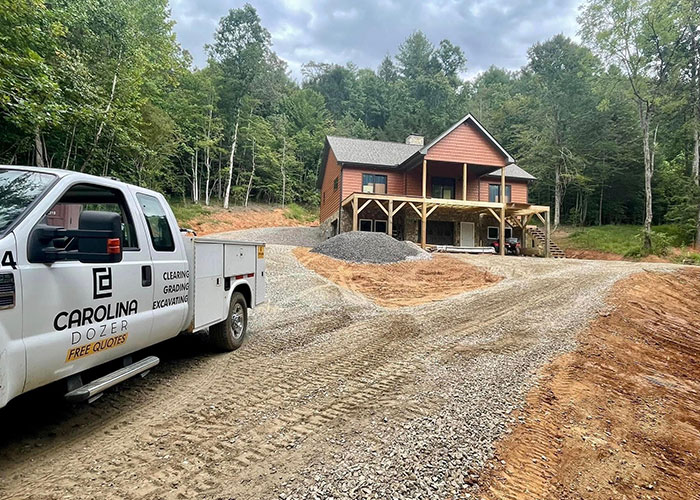
This Wilkesboro project focused on final grading around new construction. Final grade is sometimes treated as the cosmetic last step of a build, but it has a structural role in how the finished property manages water, connects to driveways and walks, and transitions from the building pad into the surrounding terrain.
During construction, the ground around a house is repeatedly disturbed by excavation, concrete work, utility installation, deliveries and equipment traffic. Temporary access routes and stockpiled soil are useful during the build but do not necessarily leave the property at the elevations it needs for long-term use.
The final grading phase is where those construction conditions are converted into finished drainage and usable landscape areas. The objective is not simply to smooth the soil. It is to establish positive drainage away from the structure while making practical transitions to the driveway, yard and undisturbed portions of the property.
Water should not be encouraged to sit against foundations or collect in low areas beside the building. The surrounding grade needs to provide a clear path away from the structure and then continue that path through the property. Creating a good slope directly beside the house but allowing the water to terminate in a low spot a short distance away does not solve the complete problem.
That is why finish grading often overlaps with drainage correction. The contractor has to look beyond the immediate foundation and understand where runoff will travel after it leaves that area.
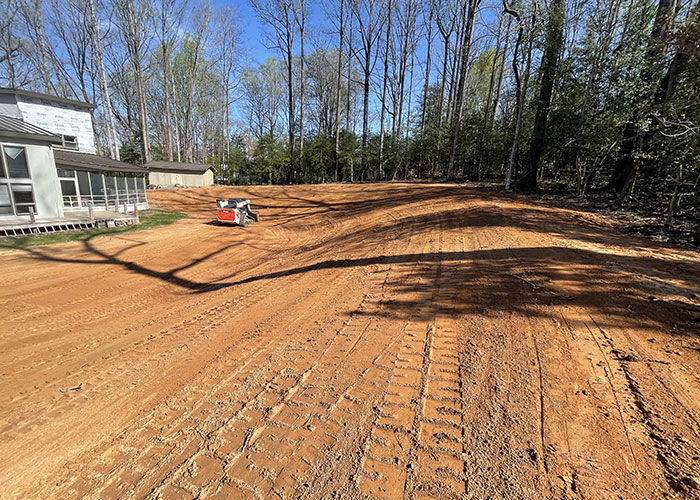
Rough construction elevations are refined gradually. High spots can be cut down, suitable material can be used to fill low areas, and transitions can be softened so the yard is practical for mowing, landscaping or other finished surfaces. The driveway and any planned lawn areas also influence the final elevations because those surfaces need to meet the house naturally.
Where topsoil or lawn preparation is part of the next phase, the final subgrade needs to leave room for that material instead of finishing too high and forcing the landscape contractor to undo completed grading.
A successful final grade should be visually clean, but its bigger value is that the site quietly works. Rain moves away from the building, the yard has usable transitions, the driveway connects cleanly, and future landscaping can proceed without major earthwork.
Carolina Dozer provides grading in Wilkesboro, site restoration and lawn grading and installation for new construction and existing properties. The reasoning is to finish the earthwork with the same attention to water and elevation that should have guided the original site preparation.
Related guide: How to Prepare a Mountain Homesite for Construction.


MEDIA
FAQ’S



.jpg)