

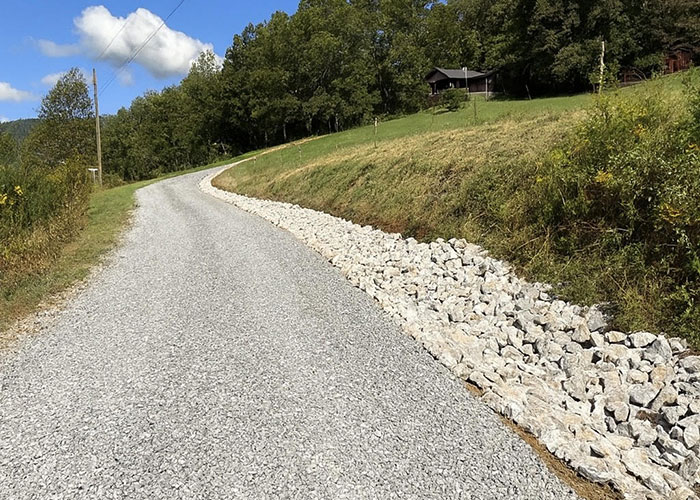
This Ferguson, North Carolina project focused on driveway grading, ditch repair and gravel spreading. It illustrates one of the most common problems with mountain and rural roads: the visible damage appears in the gravel surface, but the underlying cause is often water.
When a driveway loses crown, the roadside ditch fills in or runoff enters the road from an upper slope, water begins following the easiest downhill path. On a gravel road, that path is often one of the tire tracks. Once water is concentrated there, it gains speed, removes fines from the gravel and creates ruts that capture even more water during the next storm.
That feedback loop is why adding fresh stone alone is usually temporary. The new gravel may improve traction and appearance, but if the road still carries stormwater, the same erosion pattern returns.
The road surface needs a deliberate shape that encourages water to leave it. Depending on the section, that can mean restoring crown, adjusting cross-slope or correcting transitions so runoff reaches the ditch rather than running the length of the driveway.
The ditch has to be functional at the same time. A deep-looking ditch is not useful if it has no continuous fall or no safe outlet. Restoring the ditch creates a parallel path for runoff so the driveway can remain the travel surface.
This is the reasoning behind pairing gravel driveway repair with driveway drainage instead of treating them as separate jobs.
Grading is performed before finish gravel so the new aggregate is placed on the corrected shape rather than used to create the shape by itself. If soft or unstable areas are present, they should also be addressed before the final surface is installed. Otherwise new gravel can simply disappear into the underlying problem.
Once the road and ditch are functioning together, fresh stone can be spread and shaped as the wearing surface. At that point the gravel is doing the job it is best suited for—providing traction and a maintainable road surface—rather than trying to act as erosion control.
The goal is a driveway that sheds water sooner, holds gravel longer and requires less repetitive maintenance after storms. All gravel roads need upkeep, especially in Western North Carolina, but a road with working drainage should fail more slowly and more predictably than one carrying runoff down the wheel tracks.
This Ferguson project reflects Carolina Dozer’s broader approach to driveway and excavation work in Ferguson: find the water path first, correct the grade, then place the material.
Related guide: Why Does My Gravel Driveway Keep Washing Out?.


MEDIA
FAQ’S



.jpg)