

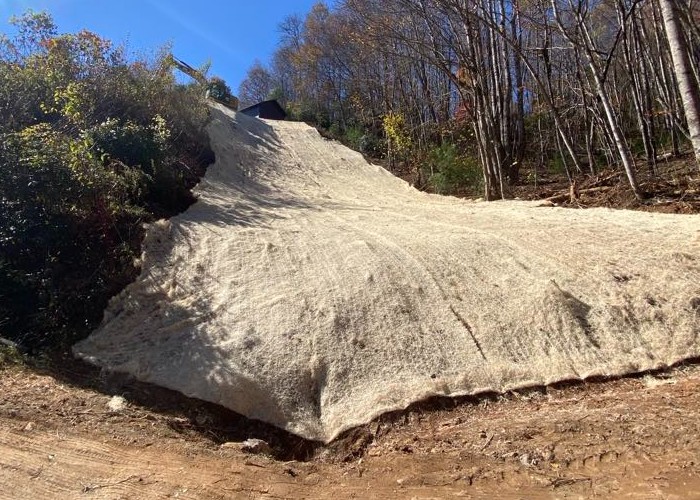
This West Jefferson, North Carolina project focused on landslide repair, mitigation and stabilization. Slope failures in the mountains are rarely caused by one visible defect. Steep terrain, concentrated runoff, previous cuts, disturbed soil and prolonged saturation can all contribute, which is why a durable repair starts with understanding the site rather than simply covering the failed area.
When a slope moves, the obvious response is to replace the lost material. But if water from an upper road, hillside or drainage feature is still reaching the same location, that replacement material may be exposed to the same forces that contributed to the original failure.
The reasoning behind mitigation is therefore broader than reconstruction. The contractor needs to consider the source of runoff, the steepness of the bank, where stable ground remains, and how equipment can safely reach the work area.
Water adds weight to soil and reduces the ability of many soils to hold a steep cut. It can also erode the toe of a bank or create channels that progressively deepen. That does not mean every landslide has a single drainage cause, but it does mean drainage should be evaluated before a new slope profile is finalized.
Where appropriate, surface-water mitigation can include diversion ditches, swales, culverts or grading that intercepts runoff before it reaches the vulnerable area.
A failed slope often needs a geometry that is more realistic for the available soil and space. That may involve removing loose material, reducing abrupt transitions or creating a shape that can be protected with stone, vegetation or other erosion-control measures.
The stabilization method should support the cause-and-effect analysis. If the primary concern is surface erosion, the solution may focus on protecting the soil. If the concern includes concentrated runoff, drainage has to be part of the repair. If access has been damaged, the road may need to be rebuilt at the same time.
The goal is not to promise that a mountain slope can never move again. The goal is to correct obvious vulnerable conditions, establish a more practical slope, improve water management where needed and leave the site in a condition that is easier to monitor and maintain.
Carolina Dozer performs landslide and excavation work in West Jefferson and Ashe County. The reasoning behind the work is to repair the visible failure while also asking what the property is doing above, below and around it—because that context often determines how the slope performs after the repair.
Related guide: How Surface Water Can Cause Erosion and Landslides.


MEDIA
FAQ’S

.jpeg)


.jpg)